

The AI Scare Trade and The Next Economic Crisis
Key Takeaways:
Investors are worried that big tech companies are spending and borrowing too much to fund AI, while others fear AI could become so advanced that it replaces large numbers of jobs. These combined concerns have added volatility to the S&P 500.
A viral essay from Citrini Research describes a possible 2028 scenario where AI-driven layoffs reduce consumer spending, weaken housing, and cause debt defaults, creating a negative economic cycle. Although it is only a thought experiment, it has increased investor anxiety.
Layoffs could push overqualified workers into lower-paying jobs, driving wages down while AI continues improving. This raises concerns about a future where productivity increases but total employment falls, making it harder for the government to respond because tax revenues would drop.
AI risk is now widely acknowledged by companies. The Conference Board reports that the share of firms citing AI-related risks jumped from 12% to 72% in two years. Investors are watching earnings reports and layoffs at companies like Amazon for signs that instability could spread beyond the tech sector.
Fear surrounding large cap tech companies that are heavily diverting resources, beyond their means, towards AI development has been a theme of investing speculation in 2026. The perceived fear is that the tech firms are leveraging irresponsible amounts of debt to fund AI development that is not being backed up with adequate profits from the AI. We have also seen countless articles on the circular financing occurring between tech firms – providing false, lofty valuations. However, the most recent concern for the general market is the opposite of AI doubt. Many investors are worried that AI will be “too good,” causing disruptions in many other industries as it replaces human jobs. The market's reaction to the fear of AI over-spending combined with the fear of the disruption it may cause has come to be known as the “AI scare trade.”
The S&P 500 capped the month of February with a notable decline that was largely triggered by a scenario published by Citrini Research. The scenario is titled “The 2028 Global Intelligence Crisis,” and it has gone viral since its publication on February 22nd. It is important to note that the essay is not a prediction but rather a single possible scenario that was created as a thought experiment. The essay outlines a world, not too far away, where AI has grown faster than most expected. As the name suggests, it is set in the year 2028. As companies saw the earnings potential that AI could provide they began their large scale layoffs of white collar workers. As companies continued to increase AI integration and as a result continued to increase layoffs of white collar workers, a negative feedback loop for the economy ensued. As AI integration increases, companies fire more workers, these workers can therefore spend less money, the consumer economy takes the initial hit, companies who take a hit from less spending need to reduce their number of high cost human workers and increase AI spending because it's cheaper and therefore the cycle continues (see diagram below on the difference between a traditional recession and the AI-driven Recession).
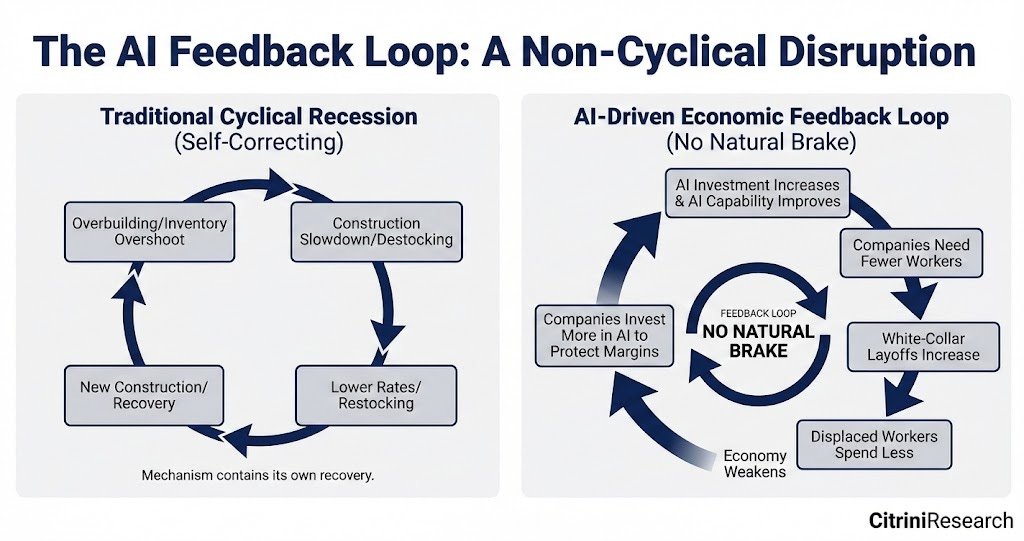
The layoffs also led to a flood of overqualified workers to lower level jobs. This consequently lowered already lower wages for the former white collar workers as a result of increased labor supply. While all of this is happening AI is growing its capabilities due to increased revenue as a result of the necessity of integration: “The engine that caused the disruption got better every quarter, which meant the disruption accelerated every quarter. There was no natural floor to the labor market” (Citrini). Next, the economic downturn spreads out of consumer and labor markets. Large software companies default on their debt because AI replaces their products, private credit and insurers face heavy losses and the housing markets weaken as displaced workers can no longer afford mortgages. The government finds it very difficult to correct the downturn because tax revenue drops as human wages drop. Economists disagree on how to best resolve the issue because “This is the first time in history the most productive asset in the economy has produced fewer, not more, jobs” (Citrini). The essay finishes with a warning to investors “you’re not reading this in June 2028. You’re reading it in February 2026. The S&P is near all-time highs. The negative feedback loops have not begun. We are certain some of these scenarios won’t materialize. We’re equally certain that machine intelligence will continue to accelerate. The premium on human intelligence will narrow. As investors, we still have time to assess how much of our portfolios are built upon assumptions that won’t survive the decade. As a society, we still have time to be proactive. The canary is still alive” (Citrini).
It is easy to see how this writing could worry investors about what is to come, but the AI scare trade is not all speculative. According to the Conference Board “From 2023 to 2025, the share of companies reporting AI-related risks jumped from 12% to 72%” (Conference Board). Finance, health care and industrials have seen the sharpest rise in AI related risks however a majority of the perceived risk stems from reputational risk if AI fails to deliver on its lofty promises.
It will be important for investors to keep an eye on earnings reports for AI involved companies and how the market reacts to them. Recently tech has been volatile and that volatility could easily spread to other industries as AI increases capabilities. Continued large scale layoffs, such as we have recently seen from Amazon, could also further scare the markets.
For further reading into how AI is affecting finance specifically check out our other insight: The AI Threat to Jobs in High Finance
Citrini - The 2028 Global Intelligence Crisis
The Conference Board - New Study: 7 in 10 Big US Companies Report AI Risks in Public Disclosures
